
Why kindness is good for business
A few years ago, I delivered a keynote to a large investment bank in Rome. At the end, during the Q&A, someone asked me what had most helped me build a global business from scratch. 'Kindness fuels everything,' I said. 'If you're kind and people trust each other, then you win. It's as simple as that.'
The room divided almost instantly. There were people nodding vigorously, and there were people pushing back hard – 'No way! Business is all competition!', 'The ruthless always succeed!' Someone pointed at Steve Jobs and Donald Trump as proof that kindness has no place at the top.
I've been thinking about that moment ever since. And I've spent the years since gathering the evidence, the case studies and the stories that prove the opposite is true. Kindness isn't the soft option. It's the smart one.
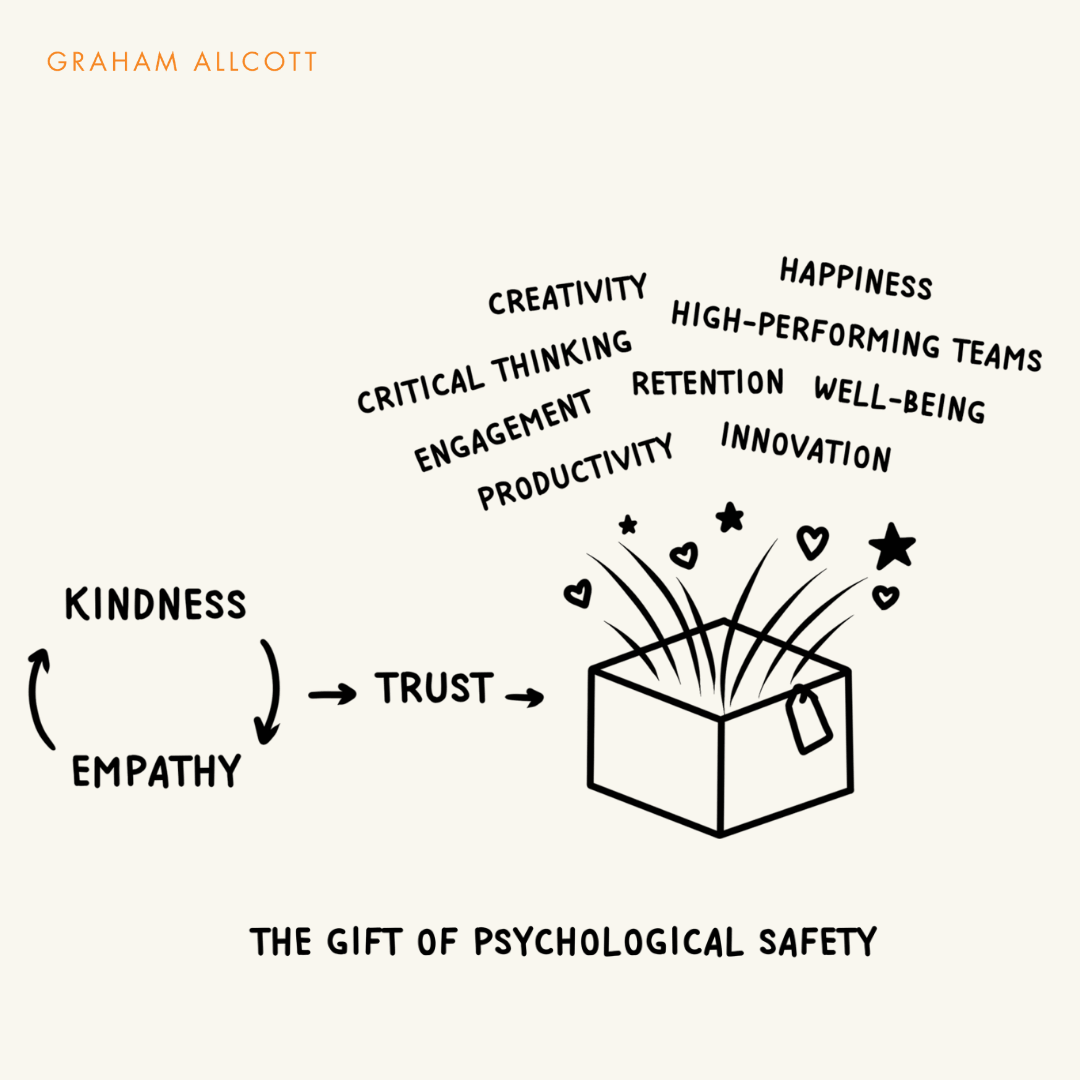
The business case for kindness
Let's start with the numbers, because I know that's what some people need before they'll listen.
Research consistently shows that kind, psychologically safe workplaces outperform their alternatives. Gallup's ongoing research into employee engagement has found that highly engaged teams show 21% greater profitability. Google's Project Aristotle – their landmark study into what makes teams effective – found that psychological safety was the single biggest predictor of team performance. Psychological safety, at its core, is kindness made structural.
Staff retention is another obvious measure. Replacing a member of staff typically costs between 50% and 200% of their annual salary when you factor in recruitment, lost productivity and onboarding time. Kind cultures, where people feel valued and connected, retain staff far better than fear-based ones. The maths isn't complicated.
And then there's creativity and innovation. Fear and threat close people down. They shrink thinking. Kindness – genuine psychological safety and trust – opens people up. Teams that feel cared for take more risks, share more ideas, and challenge more constructively.
The myth of the 'business bastard'
The prevailing narrative – reinforced by films, TV and the news – is that success in business comes from being ruthless. The Wolf of Wall Street as instruction manual. The shouty Dragon's Den judge as archetype of achievement.
But this narrative is built on survivorship bias and cinematic convenience. We remember the high-profile villains because they make better stories. We forget the much larger number of people whose unkind behaviour led nowhere, or eventually destroyed the thing they were trying to build.
Duncan Bannatyne, who built a fortune from scratch and starred in Dragons' Den for years, put it plainly: 'I'm immensely proud to say I've achieved everything without being ruthless. You don't need to be ruthless in business.' Warren Buffett – the most successful investor in history – is known for the warmth and loyalty he shows his team. His kindness isn't incidental to his success. It's part of the architecture of it.
What kindness actually does
When I talk about kindness in a business context, I'm not talking about being nice. Nice and kind are not the same thing.
Nice is the path of least resistance. It's avoiding the difficult conversation, agreeing when you shouldn't, softening feedback until it loses its truth. Nice is comfortable for the person giving it. It's rarely useful for the person receiving it.
Kind is harder. Kind means telling someone the truth with grace. It means doing the difficult thing because it's right, even when it's uncomfortable. Kind is for them. Nice is for you.
In KIND: The Quiet Power of Kindness at Work, I set out what I call the 'ripple effect' of kindness. When leaders act with genuine kindness – not performative niceness, but courageous, purposeful kindness – it spreads. It creates permission. It changes what feels normal. And it produces results: higher engagement, better retention, stronger collaboration, more creativity.
The ROI question
People sometimes ask me, 'But what's the ROI of kindness?' It's a fair question. And the answer is that the ROI is everywhere if you know where to look.
It's in the person who stays at your company because they feel genuinely valued, rather than taking the slightly higher salary offer from your competitor. It's in the client who renews because they trust you, not just because of price. It's in the team that tells you about a problem early, rather than hiding it until it becomes a crisis – because they know you'll respond with curiosity rather than blame.
James Timpson, CEO of Timpson, runs a business on the principle that looking after his people comes first. Staff get their birthday off, access to holiday homes, and the company's 'Dreams Come True' initiative has funded dental treatment, IVF and family reunions. The result? Extraordinary staff loyalty and a business that outperforms its sector. Kindness isn't draining the bottom line. It is the bottom line.
Where to start
The good news is that you don't need to overhaul your entire culture overnight. The biggest source of accidental unkindness at work isn't malice – it's busyness. When we're overwhelmed and rushing, we stop noticing people. We stop listening. We respond to emails in tones we'd never use face to face.
Slowing down a little – creating space in your calendar to actually be present with the people around you – is often the single most impactful change a leader can make. And it costs nothing.
If you're interested in going further, KIND: The Quiet Power of Kindness at Work sets out the Eight Principles of Kindfulness at Work in full. You can also download the free 8 Ways to Kindness video course and the free KIND resources pack. And if you'd like to bring this thinking to your team or organisation, find out more about my speaking here.
Frequently asked questions
Is kindness at work really good for business performance?
Yes – and the research is consistent on this. Psychological safety, trust and engagement all correlate strongly with business performance. Kind leadership isn't a soft option; it's a strategic one.
What is the difference between being kind and being nice at work?
Nice prioritises the comfort of the person giving it – it avoids difficulty and keeps the peace. Kind prioritises the needs of the person receiving it, even when that requires honesty or courage. Nice is for you. Kind is for them.
How do you create a kind workplace culture?
It starts with leaders modelling the behaviour they want to see. Clear expectations, genuine listening, slowing down enough to notice people – these are the foundations. The Eight Principles of Kindfulness at Work in KIND provide a practical framework.