

Blog

Productive Things To Do When You’re Bored
Why do we get bored?
Boredom is a complex emotion and it can be a result of several factors. It's our brain's way of telling us that it’s not finding our current activity rewarding. One common reason is a lack of stimulation or interest in our current activity. When our brains aren't engaged, they start to seek out new, more interesting things to focus on, which can lead to feelings of boredom and often lead to procrastination.
Another reason boredom kicks in is a lack of control or choice in what we’re doing. If we feel stuck in a situation that we can't change, our brains can start to switch off and boredom sets in.
Kind productivity – why kindness and high performance go together
There’s a reason why, for years, my company, Think Productive, has had “Trust and Kindness is our rocketfuel” as one of our corporate values. It stems from what we did in the early days of Think Productive. I started the business with no money other than what I could earn and put into it. We had no investors, no bank loans – pure bootstrap stuff. But I knew that if we could assemble a team and pull together, we could build a brand without the big budgets. And that then, by placing the highest levels of integrity at the centre of things, we could expect it to thrive.
Like most businesses, we are a people business. We are only as good as the last conversation we have with our customers, and what makes our work better than the competition is largely to do with intangible-but-vital qualities like care, effort, infectious geekiness and a constant sense that we will up our game. It meant asking a lot of our freelancers – we had only a small client base in the beginning, and we expected them to be salespeople and brand ambassadors to make sure there was enough work for them, as well as helping us grow the product. In return, what we could offer was the ability for them to be part of something much bigger than what any freelancer could do alone – a community of practice, being part of a company with a great reputation, working together to constantly build and evolve brilliant things. As I look back on it, building that high-trust community at Think Productive is one of the things I’m most proud of in my career.
Kind people at work succeed – here's why (and how)
There's a version of this argument that sounds like wishful thinking. Kind people succeed at work? Really? What about the people who get ahead by being ruthless, political, self-serving?
They exist. I won't pretend otherwise.
But zoom out a little. Think about the organisations and teams that perform consistently over time, not just in one good quarter. Think about the leaders people actually want to work for. Think about the workplaces where the best people stay, where creativity is high, where trust is the default.
Kindness is in all of them. Not sentimentality. Not avoiding difficult conversations. Not letting people off the hook. Kindness – real kindness – creates the conditions where great work happens and where people choose to bring their best.
Here's why that's true, and what it looks like in practice.

How to delegate at work – and why most people get it wrong
There's a moment most leaders recognise. You're looking at your to-do list and something's been sitting there for three weeks. Not because it's difficult. Not because you've forgotten. But because you're the one doing it, when honestly – genuinely, obviously – someone else could.
And yet you haven't handed it over.
You've told yourself it'll be quicker to just do it yourself. Or that the briefing would take too long. Or that you're not sure anyone else would do it quite right. Or – and this is the honest one – that you feel a bit guilty about passing it on.
Sound familiar? I thought so.
Delegation is one of those things that almost everyone agrees is important and almost no one does well. And the reason isn't usually a lack of knowledge. It's a tangle of habits, instincts and guilt that keeps us busier than we need to be.

A Culture of Well-Being at Work
Success goes hand-in-hand with well-being. When we prioritise the physical, mental, and emotional health of our team members, the positive impact ripples through our organization. In my Rev Up For The Week, this week, I talked about Ruthless Kindness. Throughout my life, I have come to realize that taking care of myself is not a selfish act but rather a necessary one to be able to face life's difficulties with strength and empathy.

Mindfulness at work – how it boosts focus, calm and productivity
Mindfulness has a bit of an image problem. Mention it in a corporate context and people picture scented candles, guided meditations, and someone from HR asking you to breathe.
But that's not what mindfulness at work actually means – at least not in any useful sense.
In How to Be a Productivity Ninja, mindfulness is one of the nine characteristics of a Ninja. Not as a spiritual practice, but as a practical one. It's about the quality of attention you bring to what you're doing. And in a world of constant interruption and fragmented focus, that quality of attention is one of the most valuable things you can cultivate.

The hidden dangers of busyness – what chronic busyness does to you
Busyness has become a status symbol. When someone asks how you are and you say 'really busy', there's a subtle social reward in it. It signals importance. It signals demand. It signals that you matter.
But here's the thing about that reward: it's concealing some serious costs. And unlike most status symbols, this one doesn't just drain your wallet. It drains your health, your relationships and your sense of who you actually are.
This isn't a post about productivity – that's a different conversation (you can read about the productivity costs of busyness here). This is about what chronic busyness does to you as a human being. The physical toll. The mental strain. The slow erosion of the things that make life worth living.

How to get a productivity boost (that actually lasts)
Most people looking for a productivity boost are really looking for two things. The first is relief – from the backlog, the inbox, the nagging sense of being behind. The second is a system that stops the same problem happening again next week.
The problem with most productivity advice is that it delivers the first thing and completely ignores the second. You get a tip, you feel briefly better, and then three days later everything is exactly as it was.
So this isn't that. What follows is the Productivity Ninja approach to getting a genuine, lasting boost – not a short-term fix.

Father's Day Reflection: The Gifts of Parenthood
On Sunday, #FathersDay filled many an Instagram and Linkedin feed, as people celebrated their dads and other father figures in their lives. I feel so lucky to have a dad who's taught me all sorts of things - things like acting with integrity, saving for a rainy day and the power of getting stuck in as part of a community. Not to mention, of course, which football teams are good and which ones are evil.

We need more role models of kind leaders in business
There's a dominant story about what effective leadership looks like. It's decisive, demanding, a little bit feared. It gets results by applying pressure. It doesn't have time for feelings.
You know the archetype. The brilliant bastard. The high-performer who's hell to work for but somehow always delivers the numbers. The leader who's celebrated in business press and studied in case studies while their former team members quietly look for jobs elsewhere.
Here's my problem with that story: it's not accurate, and it's not the whole picture. Kind leaders exist, they get results, and they build organisations that last. We just don't hear about them as much – because the drama of the difficult genius makes better copy than the quiet effectiveness of someone who simply treats people well.
That needs to change. And not just because kindness is nicer. Because it works.

Zooming into the Future of Meetings
A few years ago, we all worked in a traditional office environment. Daily commutes to work, sitting at our desks, attending work meetings, and then commuting back home were normal. These activities sunk huge chunks of time and led to stress and ironically, unproductiveness.
Fast forward to today. COVID-19 forced many businesses to adopt remote work and digital meetings as the new norm. While some struggled at first to adjust, others- the early adopters- embraced the change and realized that remote work and digital meetings can offer a lot of benefits. Some companies even realized a spike in employee productivity with the adoption of remote work.
In this blog, I explore the future of meetings and how embracing digital and remote work can help us to work smarter, not harder.

Unconscious Competence
I've been learning to DJ this year. It's the perfect hobby for me, because practising it involves sitting listening to music for hours on end, which I did before anyway. I mostly suck at it so far, but the more I practice, the more I can feel some progress and improvement happening.
As I've been learning, I've spent a lot of time thinking about the four stages of the competence model, so I thought I'd use this week's Rev Up email to talk about that model, and why it's so valuable to us in our work.

The GROW model
The GROW model is one of the best-known coaching models, with four simple stages designed to help someone get from where they are to where they want to be. And whilst a great coach will make these four stages seamless, and ask you questions you either might not have thought of or have been actively avoiding asking yourself, you can also use this process without a coach, too. When I take a step back and think about my work, this simple model helps me answer questions like "what should I be doing next?", "how do we solve this problem?", or "have I thought about this properly?".

Kindful Leadership
These principles of Kindful Leadership will enable you to create a kinder and more high-performing culture for you and your team, and help shift work culture and society at large to something better.

DEFINITION: THE 800-20 RULE
Pareto’s 80-20 rule says that about 20% of your emails will add 80% of the possible impact you can have through your use of email.
This leaves at least 80% of the emails you receive in the category of low priority, noisy, nice to have or plain useless.
I would actually go further than this and say that often when I’m coaching people, the numbers are even more extreme.

Leadership matters…
Leadership matters because the world is messy and by working together, we achieve much more than we do alone. Great leaders bring truth, order, clarity, motivation and excitement to everyone around them. Great leaders get stuff done.
Truth matters, because without it, all we see is the mess.
The rules matter - both the written and unwritten ones - because they hold leaders accountable, which makes it safer for followers to trust in their leaders.
Trust matters because it is the shortcut to every transaction (think about every boss who's had your back, or every purchase you've made with a brand you love). Without trust, there's too much due diligence, and getting stuff done becomes too difficult.
Humility matters because as a leader, how you behave when you break trust, screw up, or overstep the rules is what allows you to rebuild trust, and what allows those that follow you to see that you're open to growth and change.

Messy humans and the benefit of the doubt
One of the characteristics in How to be a Productivity Ninja is "Human, not superhero". The idea is that Productivity Ninjas seem like they have some kind of special power, but they're always still just human beings with good tools, good habits and good thinking. Embracing the idea that we do our best work in spite of ourselves, not because of ourselves, is important and liberating. It allows us to remove perfection from the equation, and hence celebrate the 99% that goes well rather than dwelling on the 1% that goes wrong.
I think that there's a real humanness to our imperfections. The bumpy and imperfect parts of us are what gives life its' flavour and challenge. Nuance and curiosity are, in my opinion, vital components of our progress as a species. But for a while I've felt that these qualities and idea of giving someone the benefit of the doubt have been lacking from our culture, particularly online. Dialogue, kindness and ideas are often abandoned in favour of identity and the quest to prove we're "right".
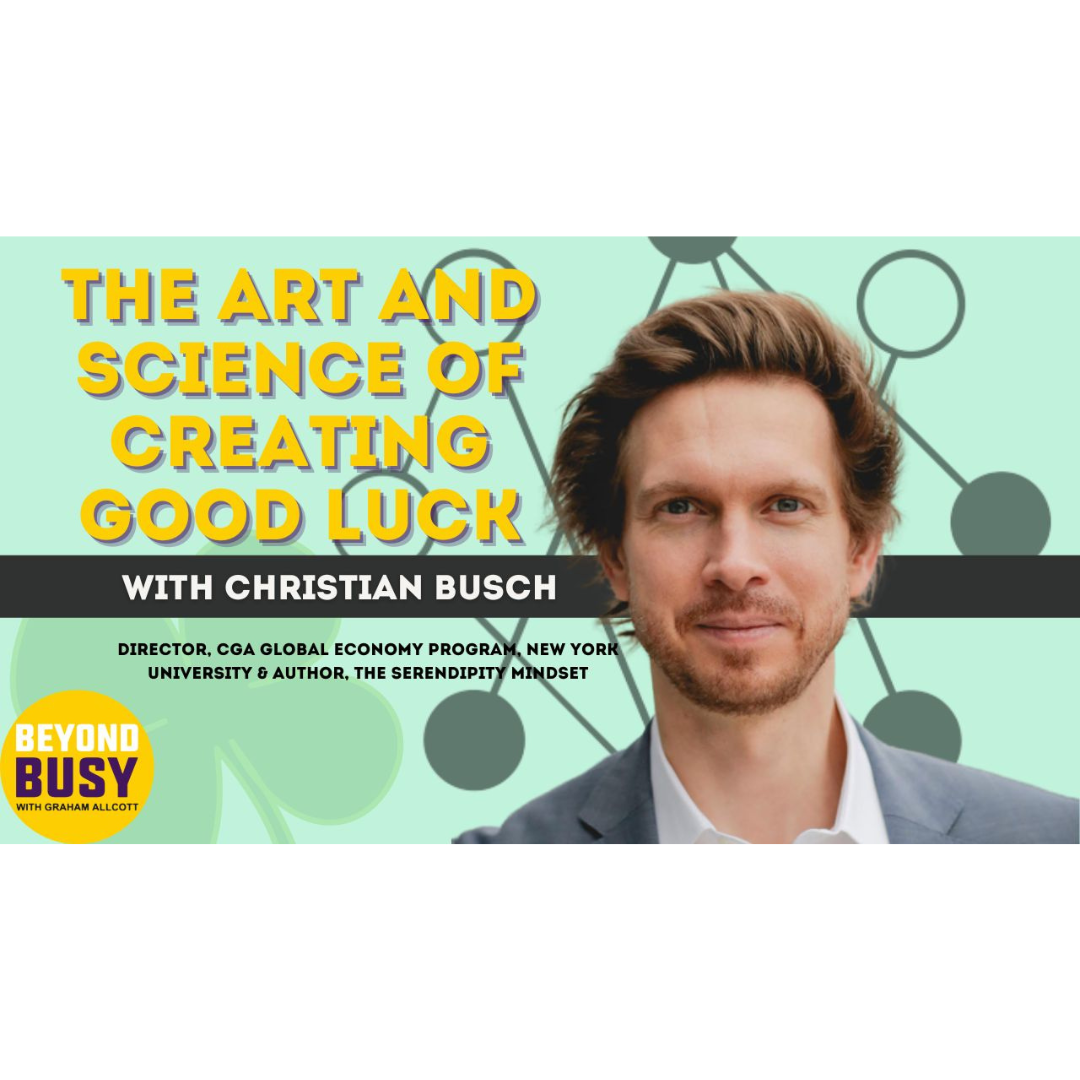
The Art and Science of Creating Good Luck with Dr Christian Busch
Graham Allcott 0:06
My guest today is Dr. Christian Busch. Christian is the director of the global economy programme at NYU, and a former director of the LSCs Centre for innovation. He advises companies all over the world on how to foster creativity, innovation, and luck. He's also the author of connects the dots, the art and science of creating good luck. So if you want to know how to get luckier in your career, this episode is for you. And we also talk about biases, curiosity, productivity, and much more. This is Dr. Christian Bush.
I'm with Dr. Christian Bush, how are you doing? Good, thank you. Great to be here. And I think I can hear Washington Square Park in the background in Manhattan. Is that right?
Dr Christian Busch 1:34
Yes, and most likely a squeaky baby, we just had a newborn.

The Secret Life of Clutter with Helen Sanderson
My guest today is Helen Sanderson. Helen is a professional organiser, and the creator of the home declutter kit. She's also the author of The Secret Life of clutter. And so, in this episode, we talk about our relationship with our stuff, the parallels between decluttering and productivity, and why it's important to get clarity in everything we do. There's a real emotional depth to the book, I really love reading it. And I hope you're going to enjoy the episode just as much. This is Helen Sanderson. How are you doing?
Helen Sanderson 1:22
I'm doing great. lovely to be here.
Graham Allcott 1:25
So welcome to Beyond Busy. And we're going to talk about your book, The Secret Life of clutter. And what's nice, if you're watching this on YouTube, you'll see Helen has a beautiful space. Just behind you there, Helen, which is like obviously just not a surprise, just meeting you. But I really enjoyed the book, The Secret Life of clutter. And I wanted to start with something that you say, which is clutter is decisions that haven't been made. So my first question is, why are people not making those decisions?
Helen Sanderson 2:01
I think we all have decision fatigue. I mean, do you remember when you used to go for a coffee, and you just get a coffee, and now it's you want a flat white or a cappuccino or an espresso or, you know, it's like, that's just one micro-moment where you're, you know, bombarded with decisions. And, you know, we have, we have busy full lives, we're also bombarded by social media, by marketing by choices. And, and I think that I think quite a lot of people run away to their home to try and get away from, you know, decision fatigue, but now it's on your computer.
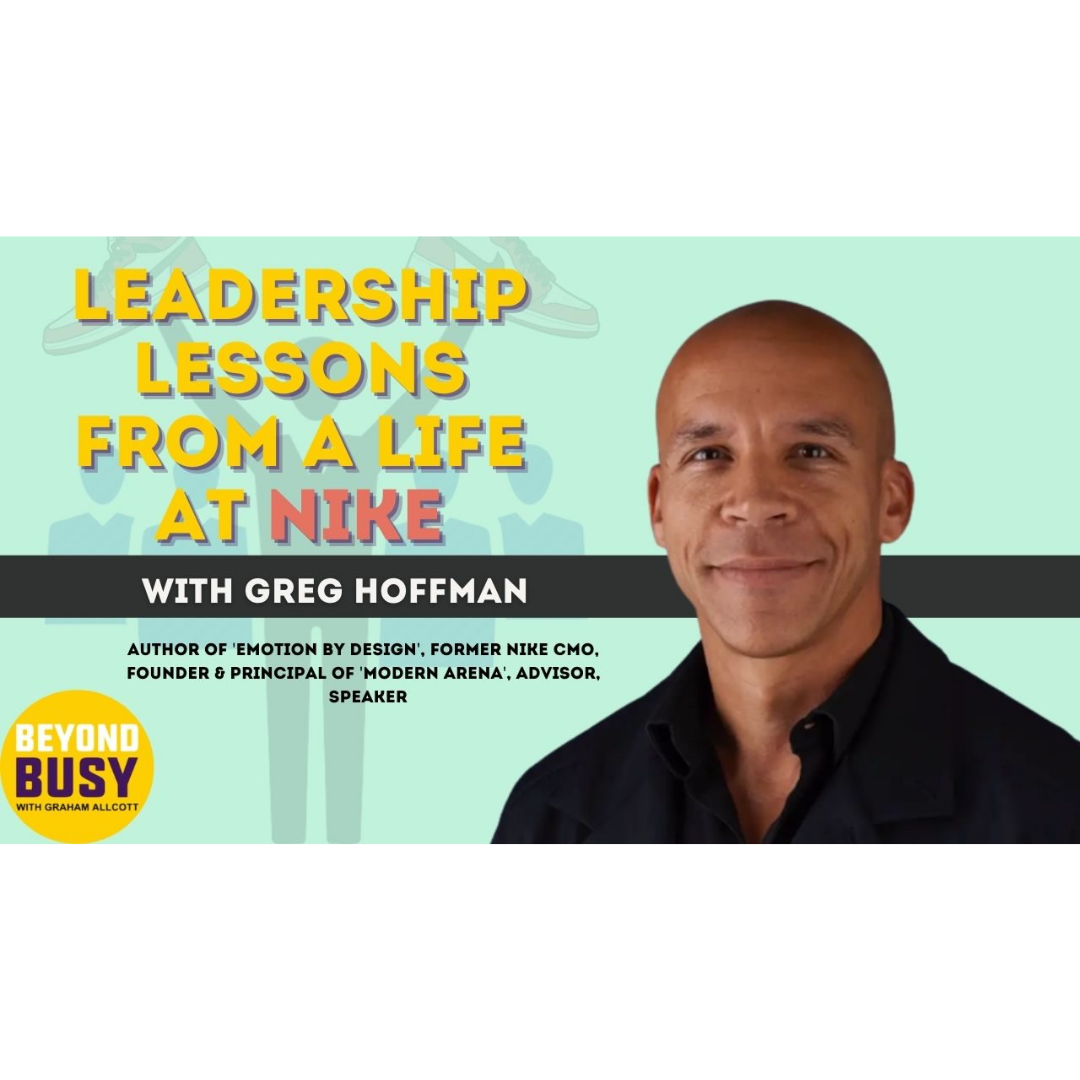
Leadership Lessons from a Life at NIKE with Greg Hoffman
My guest today is Greg Hoffman, Greg spent many years in one of the coolest jobs in the world as Chief Marketing Officer for Nike. He's also the author of a new book about his experiences in Emotion by Design. In this episode, we talked about some of the marketing campaigns that took Nike to another level, the importance of emotion and empathy in business, and why diversity increases productivity. And at the end, he shares a bit about finding his birth parents just last year. This is Greg Hoffman. So Greg Hoffman, welcome to Beyond Busy. How are you?
Greg Hoffman 1:25
I'm doing well. Thanks. Thanks for having me. It's a pleasure.
Graham Allcott 1:29
And we were just talking off air that you're, I'm catching you the day before your business, launch your book launches in the US and then obviously, is going to launch in the UK shortly after that. So I guess you are pretty busy right now.
Greg Hoffman 1:43
That's right. But it's a good kind of busy, right. So keeps you energised, and I couldn't be more happy to share these thoughts and this methodology with the world.